
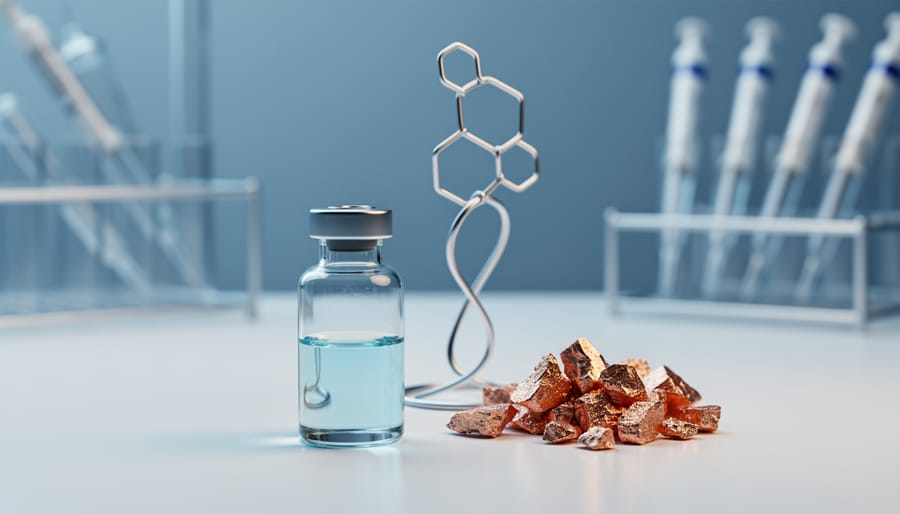
GHK-Cu is a naturally occurring copper-binding tripeptide, a tiny chain of three amino acids (glycine, histidine, and lysine) that carries a copper ion and shows up in human blood plasma, saliva, and urine. If you’re curious about the compound itself, the GHK-Cu research peptide is a good starting point for seeing how it’s described and supplied for lab study. Researchers have studied it for decades, and the interest comes down to one question: does it change which genes cells switch on and off? Lab work, including gene-expression screening of cultured cells, suggests it may influence hundreds of genes tied to tissue repair, inflammation, and cell signaling.
Here’s the honest part. Most of what we know comes from cell studies, animal models, and early skin and wound research, not large trials in athletes. So the big claims about recovery or performance run ahead of the evidence. This guide keeps things grounded. You’ll get plain-language definitions, a look at how gene-expression research actually works, the main areas scientists are exploring, and practical context for active people. Stay curious, ask good questions, and keep moving, because a strong, informed community is the best training partner there is. Explore the Wixxy Sports global directory to find events near you while you read on.
What GHK-Cu and Gene Expression Mean in Plain Language
Let’s start with the two big ideas behind all of this, because the science sounds fancier than it really is.
GHK-Cu is a tiny molecule your body already makes. It’s a peptide, which just means a short chain of amino acids (the building blocks of proteins). This one has only three, and it grabs onto a copper atom, which is where the “Cu” comes from. Researchers have found it naturally in human blood plasma, saliva, and urine.
Gene expression is how your cells read their instructions. Think of every gene as a play in a giant playbook. A cell doesn’t run every play at once. It picks the ones it needs right now and turns others down, the way a coach switches from a defensive set to a fast break depending on the moment. When a gene is “expressed,” the cell uses it to build a protein that does a job.
Here’s a quick glossary of the terms you’ll see most often:
- GHK-Cu
- A naturally occurring three-amino-acid peptide that binds copper and is studied for how it may affect cell behavior.
- Peptide
- A short chain of amino acids, smaller than a full protein.
- Gene expression
- The process cells use to switch genes up or down so they can make the proteins they need.
- Transcriptome
- The full set of gene activity in a cell at a given moment, like a snapshot of which plays are being called.
- In vitro vs. in vivo
- In vitro means studied in cells in a lab dish; in vivo means studied in a living organism.
- Extracellular matrix
- The supportive scaffolding around cells that helps hold tissues together.
So why do scientists care? If a molecule can nudge those switches, it might influence how cells respond to stress, damage, or repair. That’s an exciting question to ask, and it’s exactly what researchers are exploring. Asking the question is a long way from proving an answer, though, and that gap matters as you read on.
How Researchers Study GHK-Cu’s Effects on Genes
Think of it like scouting a rival team: you watch how they play before and after a change, then compare notes. Researchers do something similar with GHK-Cu, only the “players” are cells growing in a lab dish.
Here’s the basic process, step by step.
First, scientists grow human cells in culture, often skin cells or similar tissue types. They split these cells into groups. One group gets exposed to GHK-Cu, and another, the control group, does not. Everything else stays the same, so any difference can be traced back to the peptide.
Next comes gene-expression profiling. This is a way of taking a snapshot of which genes are turned up, turned down, or left alone. Think of it as a scoreboard showing how active thousands of genes are at once. Researchers take that snapshot from both the treated and untreated cells.
Then they compare the two. If certain genes look more or less active in the treated group, those become points of interest. It doesn’t prove the peptide caused a meaningful benefit. It simply flags where to look closer.
To make sense of all that data, researchers lean on large public databases and computational screening tools. Some studies use gene-expression databases that catalog how cells respond to many different compounds. By searching these resources, scientists can ask whether GHK-Cu produces a pattern similar to other known treatments, or whether its pattern points toward certain biological pathways.
One important thing to keep in mind: most of this work is lab-based and exploratory. Cells in a dish behave differently than a whole, moving, training human body. These studies are best seen as early clues that help shape better questions, not finished answers about recovery or performance.
What Researchers Are Studying: Key Areas of Interest
Once scientists can see which genes shift in a dish, the next question is what those genes actually do. Looking across the published work, a few themes keep coming up. Think of them as the main scouting reports on GHK-Cu, not a final scoreboard.
Here are the areas getting the most attention:
- Tissue remodeling genes: genes linked to building and reorganizing the extracellular matrix, the scaffolding that holds cells together.
- Antioxidant defense: genes involved in handling oxidative stress, the cellular wear and tear that builds up with age and heavy activity.
- Inflammation signaling: genes tied to the chemical messages cells use to ramp inflammation up or down.
- Skin and hair biology: studies on skin cells and hair follicles, where GHK-Cu has been explored in connection with repair and growth.
The tissue repair angle is probably the most talked about. Several studies have looked at whether GHK-Cu changes the activity of genes connected to collagen, other structural proteins, and the enzymes that break down and rebuild tissue. The antioxidant and inflammation work asks a related question: does the peptide nudge the cell’s own protective and signaling systems? Skin and hair research tends to be the most developed, partly because those tissues are easy to study and measure.
Now for the part that really matters: where the evidence comes from. Most of these findings come from cell cultures, meaning cells grown in a lab, and from animal models. Some small human studies exist too, but they’re limited in size and scope. A gene turning up or down in a dish is an interesting clue. It isn’t proof that anything improves in a living person, and it certainly isn’t proof of better recovery or performance.
So when you see a headline about GHK-Cu “switching on” genes, treat it as an early lead. Researchers are still figuring out what these shifts mean in real bodies, and that honest uncertainty is a normal, healthy part of how science works.
What This Research Means for Active People (and What It Doesn’t)

Here’s the honest bottom line for runners, soccer players, and weekend warriors: a change in gene activity inside a lab dish is not the same as a faster recovery time or a better finish. Scientists are still mapping what GHK-Cu might do, and most of that work hasn’t been tested on athletes in real training conditions. So it’s fine to be curious, but it’s smart to keep your expectations grounded.
Quality is another thing to keep in mind. Products labeled as GHK-Cu can vary a lot in purity, dosing, and regulation, and that’s hard to judge from a label. If you’re curious about peptides, talk with a doctor or qualified healthcare professional first. They can look at your health history and help you weigh the unknowns.
Competing in organized sport? Many governing bodies have anti-doping rules that cover certain peptides, and those rules change. Check your league or federation’s current list before you put anything in your body.
Here’s the good news: the stuff that works is within your reach right now. Consistent sleep, solid meals, sensible training loads, and planned rest days move the needle for almost everyone. Our guide to supplement basics is a good place to start, and if something feels off, athletic therapy can help you sort out injuries early. Round it out with some recovery fundamentals then explore more Wixxy Sports fitness, nutrition, and wellness resources to keep building your game.
Common Questions About GHK-Cu and Gene Expression
Here are quick answers to the questions readers ask most. The science is still developing, so a few answers come with honest “we don’t know yet” notes.
Is GHK-Cu naturally found in the body?
Yes. It’s a small peptide found naturally in human plasma, saliva, and urine, and researchers study how it interacts with copper.
Are the studies done on humans?
Mostly not. Much of the work uses cultured cells, with some animal models and small human studies, so the findings are preliminary.
Does changing gene expression mean it works for recovery?
No. Seeing genes switch up or down in a lab shows a molecule can influence cells. It doesn’t prove a real-world benefit for muscles, joints, or performance.
Is it safe to use?
That depends on the product, the dose, and the person, and product quality and regulation vary widely. Talk with a doctor before trying any peptide.
Is it allowed in competitive sport?
Rules differ by sport and governing body, and some peptides are restricted. If you compete, check your organization’s current anti-doping list first.
Where can I learn more?
Start with peer-reviewed research, your healthcare provider, and trusted sports health resources rather than product marketing.
If you want a deeper look at how professionals support active people, our guide to athletic medicine is a good next stop. It shows how qualified experts approach recovery, injuries, and long-term health.
Staying curious is a great habit. Just pair that curiosity with solid advice, and keep your focus on the basics you control every day: sleep, good food, smart training, and rest. Your best recovery plan still starts there.
GHK-Cu gene-expression research is a fascinating field, and it’s still developing. Scientists are learning how this small peptide may influence which genes switch up or down, but lab findings aren’t proven results on the track or the pitch. Staying curious and informed will always beat chasing hype.
So put your energy where it counts: sleep well, eat well, train smart, and keep moving. Those habits carry real, proven weight, and they’re fully in your hands.
Ready for your next challenge? Browse the Wixxy Sports global directory, find a local run, soccer league, or event near you, and register today. See you out there!