
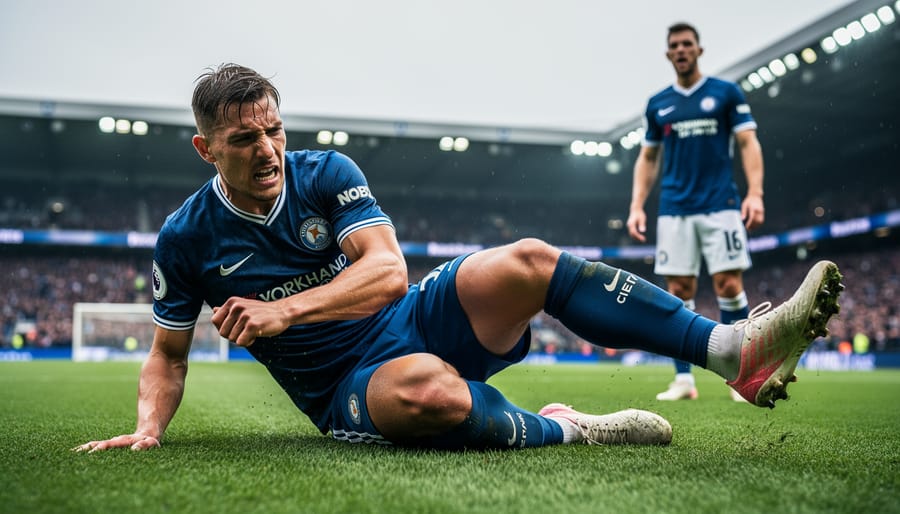
Soccer players fake injuries primarily to gain tactical advantages: drawing free kicks or penalties, forcing referees to issue cards against opponents, and breaking up the rhythm of play. It’s that simple. The behavior, officially termed “simulation,” exists because it can change the outcome of a match with a single convincing fall.
You’ve probably spotted the signs: a player collapses dramatically after minimal contact, clutches their shin in apparent agony, then jogs away moments later when the call doesn’t go their way. A 2009 study identified recognizable traits that reveal simulation, including a delay between contact and the fall, lack of continuity in the player’s movement, inconsistent contact patterns, and the telltale “Archer’s bow” pose where a player arches backward theatrically.
The game’s official rules already classify this behavior as unsporting conduct. Referees can issue yellow cards for diving and feigning injury. But enforcement remains inconsistent because officials must make split-second judgment calls in real time, often without clear camera angles.
That’s changing. The International Football Association Board approved a package of measures designed to crack down on time-wasting tactics and enhance match tempo across all competitions starting with the 2026 World Cup. These changes acknowledge what every fan already knows: simulation undermines the beautiful game and frustrates players and spectators who want to see genuine athletic competition.
Understanding why players dive helps you spot it, call it out in your local leagues, and appreciate the officials working to eliminate it from the sport we all love.
What Is Simulation in Soccer?
Simulation in soccer refers to any deliberate attempt by a player to deceive the referee by exaggerating contact, feigning injury, or pretending a foul occurred when it didn’t. The game’s rules explicitly classify this behavior as unsporting conduct that must be sanctioned, typically with a yellow card. Players engage in simulation to gain tactical advantages: winning free kicks in dangerous positions, securing penalty kicks, or drawing cards that weaken the opposition.
- Simulation
- The act of attempting to deceive match officials by pretending to have been fouled or injured when minimal or no contact occurred.
- Diving
- A common term for simulation where a player deliberately falls to the ground to create the impression that a foul has been committed against them.
- Feigning Injury
- Exaggerating or faking the severity of contact to convince the referee that a serious foul took place, often accompanied by theatrical reactions.
- Unsporting Behavior
- Conduct that violates the spirit of fair play in soccer, including simulation, which the Laws of the Game mandate must be punished with a caution.
Understanding these definitions matters because simulation undermines the integrity of the sport and frustrates fans who value honest competition. Research has identified specific physical traits that distinguish real fouls from theatrical falls, giving observers tools to spot when players are gaming the system. As the global soccer community prepares for rule enhancements at the 2026 World Cup, recognizing what simulation actually is becomes the first step in addressing why it happens and how to reduce it.
Recognizing the Signs: How to Tell If a Player Is Diving
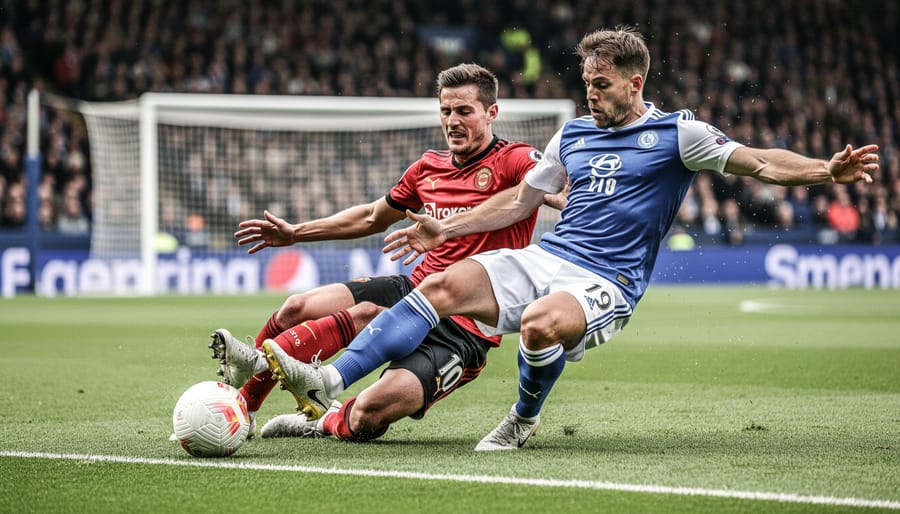
Spotting a dive in real-time takes a trained eye, but once you know what to look for, theatrical falls become easier to distinguish from genuine fouls. Researchers spent years analyzing game footage to identify the telltale patterns that separate a player who’s been legitimately fouled from one who’s putting on a performance for the referee.
A 2009 study broke down the mechanics of simulation and found four recognizable traits that appear consistently when players fake contact. These aren’t foolproof indicators on their own, context matters, and split-second referee decisions remain tough, but together they form a reliable framework for reading the authenticity of a fall.
Here’s what to watch for when you suspect a dive:
- Separation in time between impact and simulation: The player reacts to contact a fraction of a second too late, as if processing the theatrical opportunity rather than responding instinctively to a genuine foul.
- Lack of ballistic continuity: Real impacts send bodies in predictable directions based on physics. Divers often fall in ways that don’t match the supposed point of contact or the momentum they carried before the fall.
- Lack of contact consistency: The severity of the fall doesn’t align with the level of contact. A light brush on the shoulder shouldn’t send a professional athlete sprawling like they’ve been struck by a car.
- The ‘Archer’s bow’ pose: Players arch their backs dramatically mid-fall, a signature shape rarely seen in genuine collisions but common in simulation because it maximizes visibility and sells the illusion of impact.
Watch closely when a player goes down near the penalty area or in scoring position. Does the fall feel fluid and immediate, or does it look choreographed? Real fouls produce instant, uncontrolled reactions, stumbles, awkward landings, genuine attempts to stay upright. Simulation often includes that telltale pause, the exaggerated grimace, the roll across the turf that extends just a beat too long.
You’ll also notice that divers frequently glance toward the referee before or during the fall, checking whether the performance is landing. Players who’ve been genuinely fouled are focused on the play, the ball, or their own balance, not on making eye contact with officials. The face tells the story: authentic pain registers differently than the theatrical agony of a player hoping for a yellow card and a free kick.
Next time you’re watching a match, apply this framework. You’ll start seeing patterns, and the game’s unspoken theater becomes part of the tactical puzzle you’re learning to read.
Why Players Fake Injuries: The Strategic Motivations
The impulse to feign injury in soccer isn’t born from cowardice or poor character. It’s a calculated tactic, driven by a clear goal: gaining a competitive edge through referee intervention. Players dive to secure scoring opportunities via free kicks or penalty kicks, or to tilt the match in their team’s favor by drawing a yellow or red card against an opponent. The rules explicitly label such attempts to deceive referees as unsporting behavior, yet the potential rewards remain powerful enough that some players consider the risk worthwhile.
Winning at the highest level demands razor-thin margins, and simulation offers a shortcut to advantage. A well-sold dive in the penalty area can conjure a goal from nothing. A theatrical fall near midfield can slow the opposition’s counter-attack or earn a booking that puts a dangerous player on thin ice. The stakes amplify the temptation: in knockout tournaments, continental finals, or qualification battles, a single dive might swing a season or a nation’s World Cup hopes. The win-at-all-costs mentality thrives in that pressure, and simulation becomes one more arrow in the tactical quiver.
| Motivation | Tactical Benefit | Potential Consequence |
|---|---|---|
| Penalty area dive | Converts weak position into penalty kick scoring chance | Yellow card for simulation; loss of credibility with referees |
| Midfield exaggeration | Stops opponent’s counter-attack; may earn opponent a booking | Yellow card; reputation damage; no stoppage if referee sees through it |
| Time-wasting fall | Runs down clock when protecting a lead | Yellow card; referee adds stoppage time; crowd backlash |
Players also know that referee decisions are subjective, made in real time under enormous scrutiny. A convincing performance can exploit that split-second judgment call, and once the whistle blows, the advantage is locked in. The deeper the match pressure and the higher the competition level, the stronger the incentive to push ethical boundaries. It’s a gamble between short-term gain and long-term reputation, and the scoreboard often wins that argument.
What’s Being Done: Rules, Penalties, and 2026 Changes
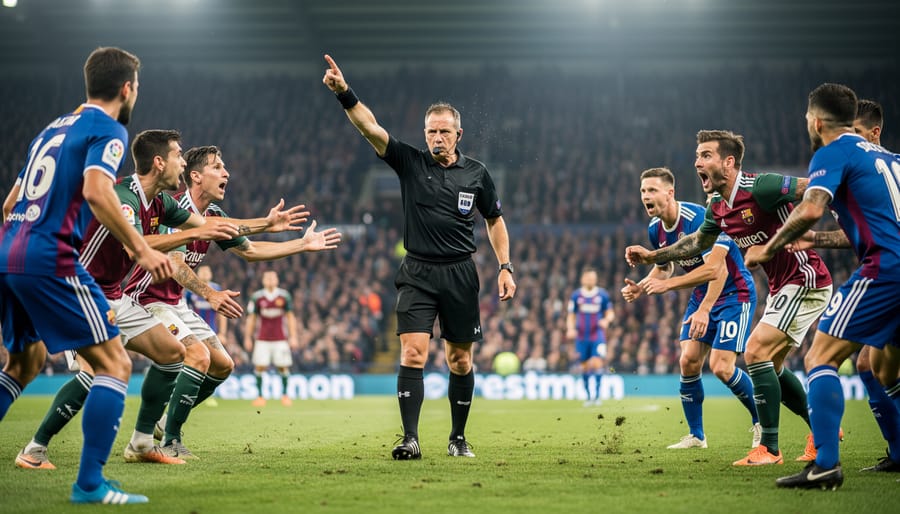
Soccer’s governing bodies have moved decisively to tackle simulation, and the fixes are already in motion. The current rules provide the foundation: any player caught diving or feigning injury receives a yellow card for unsporting behavior. Referees can also issue cards retroactively if they miss the incident during play but catch it on review. Accumulate enough yellow cards across a tournament or season, and you face suspension. That immediate penalty shifts the risk-reward calculation for players weighing a theatrical fall against the chance of being caught.
The enforcement framework operates in stages, each building on the last to close loopholes and speed up the game:
- Current rules establish yellow cards as the standard sanction for simulation, giving referees clear authority to penalize diving during live play or after video review.
- The IFAB approved a comprehensive package of measures designed to enhance match tempo and reduce time-wasting across the game, addressing not just diving but all behaviors that slow play and break momentum.
- The meeting in Hensol, Wales formalized these rule changes, signaling unified commitment from soccer’s international rule-making body to prioritize fair play and game flow.
- Implementation begins at the 2026 FIFA World Cup and extends to all other competitions, ensuring consistent enforcement from grassroots leagues to the sport’s biggest stage.
These measures target the environment that makes simulation attractive. By cutting down on stoppages and rewarding continuous play, the new rules give honest players an advantage. Referees get clearer guidelines, video review provides accountability, and the global rollout means no competition becomes a haven for theatrics. The 2026 World Cup serves as the high-profile launch point, putting the sport’s best players under the brightest spotlight to demonstrate that skill matters more than acting ability.
The approach recognizes that you can’t legislate sportsmanship into existence overnight. Instead, the fix layers penalties, procedural changes, and public enforcement to shift the culture. Players learn that staying on their feet and playing through contact earns respect, while habitual divers face cards, suspensions, and reputational damage. Coaches adjust tactics knowing that wasting time through fake injuries now costs more than it gains.
How Players, Coaches, and Fans Can Prevent Simulation
Preventing simulation starts at every level of the game, from grassroots pitches to professional stadiums. Coaches play a crucial role by embedding fair play into their training philosophy, rewarding skillful dribbling, tactical awareness, and resilience instead of theatrics. When youth players see that honest effort earns recognition and playing time, they learn that reputation is built on ability, not acting. Teaching youth soccer sportsmanship early creates a culture where diving feels out of place, and players understand that integrity matters as much as the scoreline.
Players themselves can choose a different path. Building a reputation on skill, speed, and smart positioning earns respect that lasts far longer than a single dubious penalty. Fans notice who stays on their feet under pressure, and teammates trust players who don’t compromise the squad’s credibility. At the community level, celebrating honest competition shifts the spotlight away from gamesmanship and toward genuine achievement.
Fans and communities hold influence too. Cheering hard tackles won fairly, applauding players who wave off undeserved calls, and supporting local leagues that prioritize sportsmanship all send a clear message: theatrics won’t be rewarded here. Wixxy Sports connects fans with participatory soccer events worldwide, offering a platform to find leagues and tournaments where fair play is the standard. Whether you’re coaching a team learning field dimensions by age or supporting your local club, your voice matters. When players, coaches, and supporters unite around integrity, the game becomes what it was meant to be: a test of skill, not performance art.
Common Questions About Diving and Simulation
What is simulation in soccer?
Simulation is an attempt by a player to deceive the referee by falling to the ground and faking injury to give the impression that a foul has been committed. The game’s rules classify it as unsporting behavior that must be sanctioned, as it seeks to gain an unfair advantage through deception rather than skill.
Why do soccer players fake injuries?
Players fake injuries to gain tactical advantages like winning free kicks, penalty kicks, or drawing yellow and red cards for opponents. In high-stakes matches, these advantages can shift momentum or change the outcome, creating pressure to exploit any opportunity for a competitive edge.
Why do soccer players receive yellow cards for diving?
Referees issue yellow cards for simulation because it violates fair play principles and attempts to manipulate match officials. The sanction aims to discourage deception and protect the integrity of the game, though enforcement varies based on how clearly the referee identifies the dive.
How can you tell if a player is diving?
A 2009 study identified recognizable traits: separation in time between impact and the fall, lack of ballistic continuity in the player’s motion, inconsistency between the contact point and reaction, and the theatrical ‘Archer’s bow’ pose where the back arches dramatically. Real injuries typically show immediate, natural reactions to genuine contact.
Understanding these fundamentals helps fans watch matches with a sharper eye, though even seasoned observers get fooled occasionally. The global soccer community, from grassroots leagues in your neighborhood to discussions in soccer betting communities, increasingly values transparency and fair play over gamesmanship. As the 2026 World Cup approaches with stricter enforcement measures, conversations about simulation are shifting from accepting it as “part of the game” to demanding higher standards of sportsmanship across all levels of competition.
Simulation will always be part of soccer’s tactical landscape, but the game is moving toward a fairer future. With the 2026 World Cup set to implement stronger rules against time-wasting and diving, players who rely on theatrics will face stiffer consequences. Referees are better trained, fans are more informed, and the global soccer community is demanding honest competition.
You can be part of that shift. Whether you’re a player building your reputation on skill rather than exaggeration, a coach teaching fair play, or a fan celebrating integrity over gamesmanship, your voice matters. Understanding the difference between genuine injuries requiring athletic therapy and theatrical recovery and recovery claims empowers you to call out simulation when you see it.
Want to experience soccer rooted in community and sportsmanship? Explore Wixxy Sports’ global directory to find local leagues, tournaments, and events near you. Get involved, play fair, and help shape a game where talent wins over tactics.