
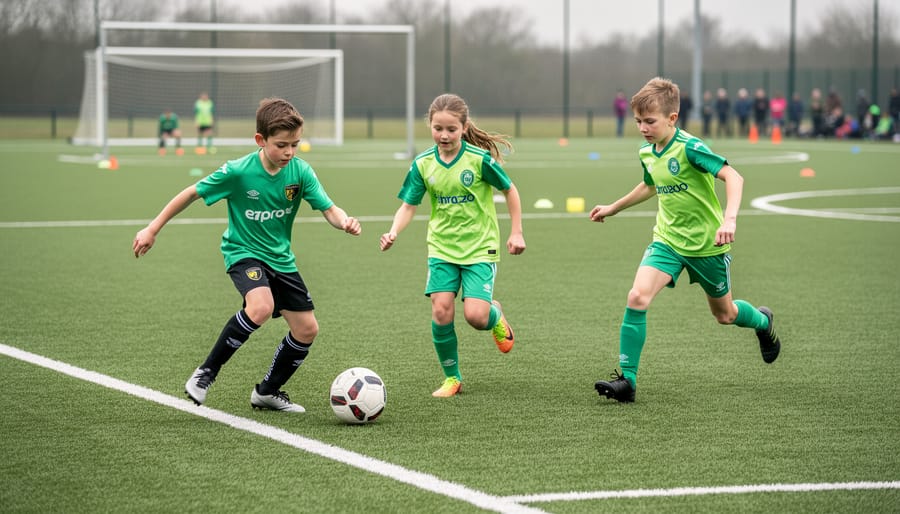
Youth soccer field dimensions are scaled-down playing areas specifically designed for children, with sizes that decrease in proportion to the age and skill level of the players. Unlike standard adult pitches, these fields accommodate formats ranging from small-sided games for beginners to full 11v11 matches for older youth players, ensuring the game remains age-appropriate and developmentally beneficial.
Getting the dimensions right matters more than most parents and coaches realize. A field that’s too large exhausts young players before they can develop skills, while one that’s too small crowds the action and limits learning opportunities. For parents watching their child’s first season or coaches planning field setup for 2026 leagues, understanding these measurements helps you assess whether your local facility meets recommended standards and supports proper player development.
The sizing system responds directly to how children grow and learn the game. A six-year-old simply can’t cover the same ground as a teenager, and their tactical understanding differs dramatically. Youth field dimensions reflect this reality by creating playing environments where kids can actually reach the ball, make decisions before exhaustion sets in, and experience success that builds confidence. Fields for ages 6 to 8 typically measure 25 to 35 yards long and 15 to 25 yards wide, creating compact spaces perfect for teaching basic ball control and positioning. As players mature, dimensions expand gradually to introduce more complex spacing, longer passes, and fuller team tactics that mirror the adult game.
What Youth Soccer Field Dimensions Mean
Youth soccer field dimensions are the official measurements, length, width, goal size, and markings, for soccer fields specifically designed for players under 18. These specifications ensure that younger athletes play on pitches scaled to their physical capabilities, allowing them to develop skills, stamina, and tactical understanding in an environment that fits their developmental stage. Unlike adult fields, which follow standard FIFA regulations of 105 metres by 68 metres, youth fields shrink proportionally as players get younger.
The scaling exists because children have shorter strides, less endurance, and different spatial awareness than adults. A full-size pitch would exhaust a seven-year-old and make learning proper positioning nearly impossible. By reducing field size, governing bodies like US Youth Soccer and FIFA create age-appropriate challenges that keep kids engaged without overwhelming them. As players grow and improve, the dimensions gradually expand, mirroring the progression you might see in athletic therapy programs that adjust training loads to match physical development.
Organizations determine these standards through research on child development and feedback from coaches and sports scientists. The result is a tiered system where each age bracket has recommended measurements, often published in a youth field size chart that leagues and clubs reference when marking fields.
- Field of play
- The rectangular playing area bounded by the touchlines and goal lines, excluding the surrounding out-of-bounds zones.
- Touchline
- The longer boundary line running along the length of the field on each side.
- Goal line
- The shorter boundary line at each end of the field where the goals are positioned.
- Penalty area
- The marked zone extending from the goal line into the field where goalkeepers can handle the ball and fouls result in penalty kicks.
- Goal box
- The smaller rectangle closest to the goal, marking the area from which goal kicks are taken.
Understanding these terms helps parents and coaches communicate clearly about field setup and ensures that every young player experiences soccer in a space built for their age and ability.
How Youth Field Sizing Works
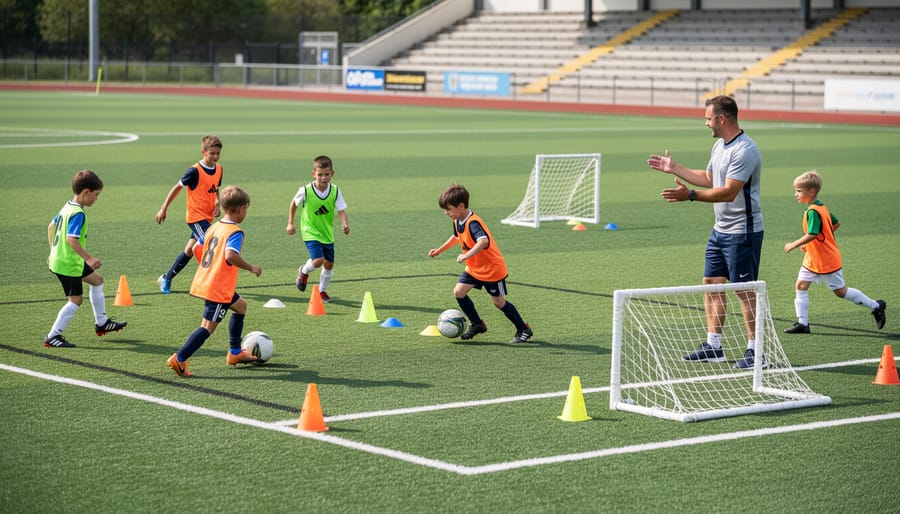
Youth soccer field sizing follows a deliberate age-based progression designed to match players’ physical and cognitive development. Rather than placing all young athletes on regulation pitches, governing bodies like US Youth Soccer and FIFA have established scaled dimensions that grow alongside children’s capabilities.
The system starts with the youngest age groups on the smallest fields, typically 25-35 yards long and 15-25 yards wide for 6-to-8-year-olds playing 4v4 or 5v5 formats. As players mature and develop better stamina, spatial awareness, and tactical understanding, field dimensions expand proportionally. This progression continues through 7v7 formats for Under 10s, 9v9 for Under 12s, and eventually full 11v11 games on near-regulation fields for teens.
The rationale centers on player development rather than mimicking adult soccer. Smaller fields for younger children mean more touches on the ball, faster decision-making opportunities, and appropriate physical demands. A six-year-old running the length of a full-size pitch would quickly fatigue and lose engagement, while a compact field keeps them involved and learning. Similarly, goal sizes scale down so young goalkeepers can realistically defend their nets and build confidence rather than feeling overwhelmed.
US Youth Soccer provides detailed guidelines that most American leagues adopt, while FIFA’s standards inform international youth development programs. These organizations base their recommendations on decades of player development research and best practices from youth sports programs worldwide. The result is a structured framework that supports proper skill acquisition at each stage.
This scaling also connects to broader athletic development principles, including appropriate conditioning for soccer tailored to young bodies. By age 14, most players transition to full-size fields approaching FIFA’s recommended 105m x 68m dimensions, completing their progression through youth soccer’s carefully designed pathway.
Field Dimensions by Age Group
Under 6 and Under 8 (Ages 6-8)
For the youngest organized soccer players, fields are dramatically smaller than what you see on television. At ages 6-8, U6/U8 field dimensions range from 25 to 35 yards in length and 15 to 25 yards in width (22.9-32 meters by 13.7-22.9 meters). These compact sizes suit children who are still developing coordination and learning basic ball control.
Games at this level typically use 4v4 or 5v5 formats, which give each child more touches on the ball and reduce overwhelming open space. The reduced player count also keeps the action manageable for kids who are just grasping positional concepts.
Goal sizes scale down proportionally, usually measuring around 4 to 6 feet tall and 6 to 12 feet wide, though exact dimensions can vary by league. These smaller goals let young goalkeepers actually reach shots without needing adult wingspan.
The compact field setup serves a developmental purpose: children at this age have limited stamina and attention spans. Shorter distances mean they spend less time chasing the ball and more time engaged in actual play, building foundational skills like passing, dribbling, and spatial awareness in a setting they can physically handle.
Under 10 (7v7 Format)
At the Under 10 level, youth soccer transitions to a 7v7 format with fields measuring 45-60 yards in length and 35-45 yards in width. These dimensions give players more room to develop passing skills and spatial awareness while keeping the game manageable for their physical capabilities.
Goals at this age typically measure 6.5 feet high by 18.5 feet wide, though acceptable ranges exist (minimum 6ft x 18ft, maximum 7ft x 21.5ft). The larger goal size compared to younger age groups encourages shooting from distance and helps goalkeepers build positioning skills.
Penalty areas extend either 8 yards wide by 4 yards deep or 12 yards wide by 5 yards deep from the goal line, depending on league standards. The goal box sits within this area, usually measuring 4 yards from each post and extending 4 yards into the field.
This intermediate field size bridges the gap between small-sided games and full 11v11 play. Players experience more touches on the ball than they would on a full-size pitch, yet they learn to look up and find teammates across greater distances. The 7v7 format typically suits players aged 9-10, preparing them for the jump to 9v9 fields in subsequent years.
Under 12 (9v9 Format)
At the Under 12 level, youth soccer transitions to a 9v9 format with fields measuring 40-55m in length and 45-90m in width. Most leagues aim for fields around 55m long to give players more space for tactical development while keeping dimensions manageable for 10- and 11-year-olds.
Goal dimensions at this age group are larger than younger brackets but still scaled appropriately. The ideal goal size is 6.5ft high by 18.5ft wide (1.98m x 5.46m). Some leagues allow maximum dimensions of 7ft x 21.5ft (2.13m x 6.55m) or minimum measurements of 6ft x 18ft (1.83m x 5.49m), depending on available equipment and local standards.
Penalty areas for 9v9 fields typically measure either 8 yards wide by 4 yards deep or 12 yards wide by 5 yards deep, extending from the goal line into the field of play. These scaled-down penalty boxes help young goalkeepers manage their area effectively while teaching defenders proper positioning.
The 9v9 format strikes a balance between small-sided games and full-field play, giving players more touches on the ball than 11v11 while introducing them to positional responsibilities they’ll need as they grow.
Under 14 and Older (11v11 Full Field)
By Under 14 (U-14) and older, youth players move to the full 11v11 format on fields that closely match adult standards. At this stage, field dimensions typically range from 100 to 130 yards (91-119m) in length and 50 to 100 yards (46-91m) in width, with many competitive leagues adopting measurements near the FIFA full-size pitch recommendation of 105 metres by 68 metres. Goals reach regulation size, 8 feet high and 24 feet wide (2.44m x 7.32m), and all markings mirror professional layouts, including full-depth penalty areas and center circles.
This transition usually happens between ages 13 and 14, preparing players for high school, club, and eventually adult soccer. The larger playing surface demands greater stamina, spatial awareness, and tactical understanding, reflecting the physical and cognitive development of teenage athletes. Coaches emphasize positional discipline and team shape on these expansive fields, ensuring players are ready for the next competitive level. For families scouting programs with proper facilities, confirming that U-14-and-up teams play on regulation-size fields is a strong indicator of a well-organized, development-focused league.
Key Components of Youth Field Markings
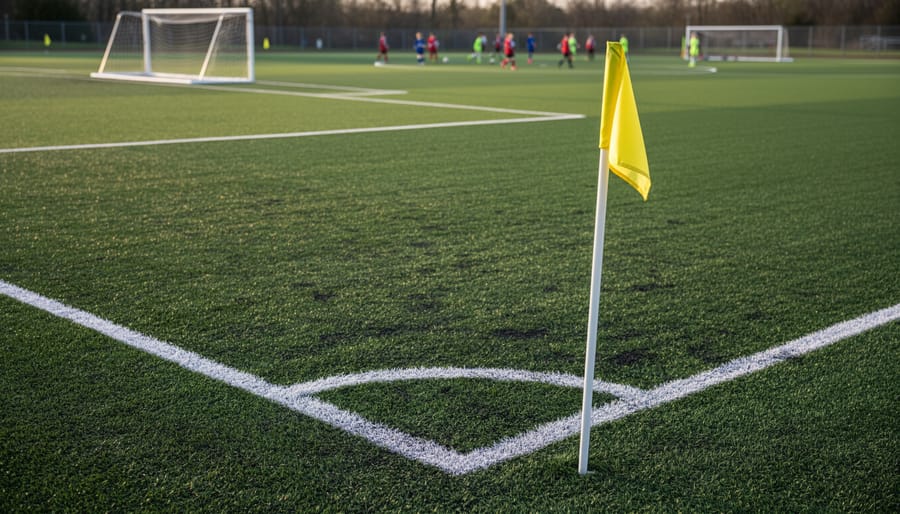
Youth soccer fields feature the same fundamental markings you’ll find on professional pitches, just scaled down to match smaller dimensions. Understanding these zones helps coaches set up proper training sessions and ensures league games meet official standards.
Every youth field includes these essential markings:
- Center line, divides the field into two halves and marks where kickoffs occur
- Penalty area, the rectangular zone in front of each goal where goalkeepers can handle the ball
- Goal area (goal box), smaller rectangle closest to the goal, marking where goal kicks are taken
- Corner arc, quarter-circle marks at each corner where corner kicks are placed
- Halfway line, runs across the width of the field at midpoint, connecting both touchlines
The proportions change with field size. On a 7v7 pitch for Under 10 players, the penalty area typically measures 8 yards wide by 4 yards deep, while 9v9 fields for Under 12s expand to 12 yards wide by 5 yards deep. By the time players reach 11v11 formats, penalty areas approach adult dimensions of 18 yards.
Touchlines (sidelines) and goal lines (end lines) define the boundaries, with corner arcs measuring 1 yard radius regardless of age group. The center circle, where opposing players must stand during kickoffs, scales from 5 yards for smaller fields to the standard 10-yard radius on full-size pitches. Field managers marking lines for youth games need accurate measurements for their specific format, as improperly sized zones can affect gameplay and rule enforcement.
How Youth Soccer Field Dimensions Are Used in Practice
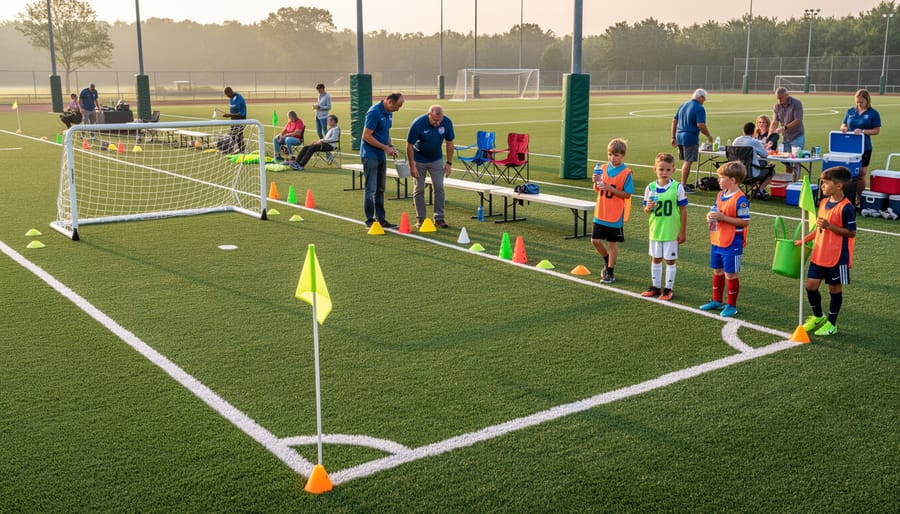
Leagues and clubs implement age-appropriate field dimensions by adapting existing facilities to accommodate multiple game formats on the same property. Many organizations use portable goals and temporary line markings to convert full-size fields into smaller zones for younger players. A single adult pitch can typically host two or three U8 fields side by side, allowing clubs to maximize facility use during busy youth soccer summer seasons when demand peaks.
Multi-purpose athletic complexes often paint multiple sets of lines in different colors to designate boundaries for various age groups. Coaches walk fields before sessions to identify which color corresponds to their format (7v7, 9v9, or 11v11). When space is limited, leagues sometimes approve slight dimension adjustments within allowed ranges. For example, a U12 field might measure 50 meters long rather than the full 55-meter recommendation if the available area restricts expansion.
Parents searching for programs can use local sports directories to identify clubs with properly sized facilities for their child’s age bracket. These platforms typically list field specifications alongside registration details, helping families choose programs that provide age-appropriate playing environments. Field quality matters just as much as coaching when evaluating youth programs, since correct dimensions directly impact skill development, game flow, and injury prevention. Coaches should verify that their assigned fields meet minimum standards before the season starts, requesting adjustments if goal sizes or penalty areas fall outside official guidelines.
Frequently Asked Questions
How big is a standard youth soccer field?
Youth soccer fields vary by age group, ranging from 25-35 yards long and 15-25 yards wide for the youngest players (ages 6-8) up to full-size fields approaching 105m x 68m for older teens playing 11v11. The field size scales with the age and developmental stage of the players to create appropriate playing environments.
What are the exact field dimensions for ages 6-8?
For players aged 6-8, fields measure 25-35 yards in length and 15-25 yards in width (22.9-32m x 13.7-22.9m). These compact dimensions support 4v4 or 5v5 game formats and allow young players to develop fundamental skills without excessive running distances.
How do youth soccer pitch markings differ from adult fields?
Youth pitch markings maintain the same basic structure as adult fields, goal lines, touchlines, center circle, penalty areas, and corner arcs, but scale proportionally to the smaller field size. For example, 9v9 penalty areas measure 8 yards wide by 4 yards deep, significantly smaller than regulation adult dimensions, making the playing zones age-appropriate.
What goal size should be used for youth soccer?
Goal dimensions vary by age and format. For 9v9 games, the ideal goal size is 6.5ft x 18.5ft, with a maximum of 7ft x 21.5ft and minimum of 6ft x 18ft. Younger age groups use even smaller goals, while older teens playing 11v11 transition to full-size goals measuring 8ft x 24ft.
Parents and coaches organizing youth soccer activities often need quick answers to these measurement questions when setting up practice sessions or evaluating facilities. Understanding these specifications helps ensure that playing environments match developmental needs and league requirements. If you’re looking for properly sized fields and organized youth programs in your area, platforms like Wixxy Sports connect families with local leagues that maintain appropriate field dimensions for each age group. Just as planning around a women’s soccer schedule requires knowing venue details and timing, selecting youth programs means confirming that facilities offer correctly sized fields for your child’s age bracket. The right field dimensions make practices more effective and games more enjoyable for developing players.